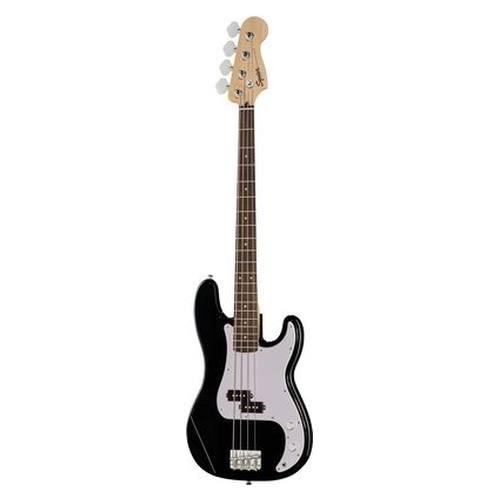
Sonic P Bass
☆ Top Pick
Squier Sonic Precision Bass
Price history
We have been recording this product's price at its dealers since July. Player members see the 90-day trend, what it has been at its highest and lowest, and whether today is actually a good day to buy it.
The Sonic is a beginner-focused Precision Bass from Squier, and it keeps the part of the design that matters: one split single-coil pickup in the middle of the body, a volume knob and a tone knob. That layout is behind a huge share of the bass you have heard on pop, rock, soul and punk records, which makes it an easy first bass to learn real songs on.
Fender describes the body as thin and lightweight. It is poplar with a gloss finish, bolted to a maple neck with a satin finish and a C-shaped profile. The nut is a narrow 1.5 inches (38.1 mm), so your hand does not have to stretch, and the fingerboard (Indian laurel or maple, depending on the finish) has a 9.5 inch radius with 20 narrow tall frets. The bridge is a four-saddle hardtail, so there is no tremolo arm to knock it out of tune.
Key Specs
- Poplar body, gloss polyurethane finish
- Bolt-on maple neck, satin finish, C shape
- Indian laurel or maple fingerboard, 9.5 inch radius, 20 narrow tall frets
- 34 inch scale, 1.5 inch (38.1 mm) synthetic bone nut
- One ceramic split single-coil pickup (passive)
- Master volume and master tone
- Four-saddle hardtail bridge, vintage-style open-gear tuners, nickel-plated strings (.045 to .105)
Why it made the list
It is the most useful bass here for the money. At $269.99 you get the classic P Bass sound, a full-scale neck that will not feel like a toy, and a slim build that is forgiving for the first few months of sore fingers. There is nothing to learn about the controls, because there are only two.
The Sonic is also the bass to choose if you might move to a better one later. Everything you learn on a 34 inch P Bass transfers directly to a Fender Precision Bass costing several times as much, and the passive circuit teaches you to shape your tone with your fingers and your amp, not with a stack of knobs.
Deep Dive: Who It's Really For
The ideal buyer: A beginner of any age who wants a standard-size bass and a sound that fits rock, pop, funk, punk and country. If you can name the bassist on a song you love, there is a good chance the sound you heard came from a P Bass.
What you give up: There is one pickup and no active circuit, so the tonal range is narrower than the Ibanez or the Yamaha below. A passive bass also has a quieter output, which is normal, but it means the amp or interface gain matters more.
What to budget alongside it: Fender lists only setup wrenches as accessories, so you will need a cable, a strap and a bass amp or an audio interface. A guitar amp is not built for the low end and can be damaged by it, so get something labeled for bass. A professional setup (string height, intonation) costs far less than moving up a price tier and helps any bass on this list.
▶ Featured Review
Video Reviews & Tutorials
Squier Sonic Precision Bass Tone Demo
Sound Demo

Squier Sonic Precision Bass California Blue Unboxing / Review
Full Review

Squier Sonic Precision Bass Unboxing & First Impressions
First Look
Pros
The classic P Bass layout, behind a huge share of recorded bass, at a beginner price Narrow 1.5 inch nut and a thin body suit smaller hands and younger players Two controls, so there is nothing to get lost in Hardtail bridge keeps tuning stableCons
One pickup and a passive circuit give the narrowest tonal range here No gig bag, cable or strap in the box Ceramic pickup is less refined than what you get at the next price tier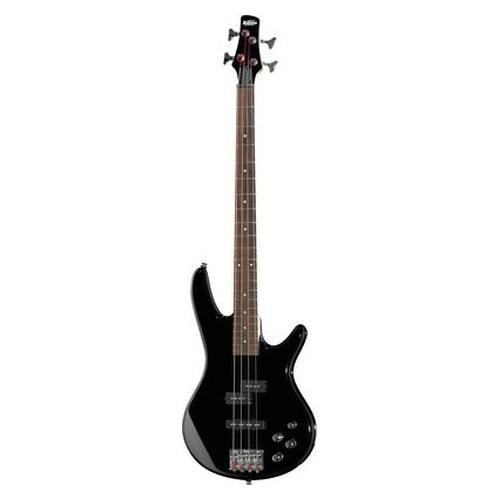
Gio GSR200
Best Tone Control
Ibanez Gio GSR200
Price history
We have been recording this product's price at its dealers since July. Player members see the 90-day trend, what it has been at its highest and lowest, and whether today is actually a good day to buy it.
The GSR200 is the budget bass in Ibanez's SR line, and it is the one with the most knobs for the money. It pairs a P-style neck pickup with a J-style bridge pickup (the so-called PJ layout), and a Phat II active bass boost sits on top of a regular tone control. Blend the two pickups for a rounded, full sound, or favor the bridge for a tighter, more nasal growl that cuts through a guitar-heavy mix.
The body is poplar and the neck is a thin maple one with a jatoba fingerboard and 22 medium frets. Ibanez publishes the neck at 21 mm thick at the first fret and 22 mm at the twelfth, with a 41 mm nut and a flat 305 mm radius, so it is a slim, fast neck. The bridge is a B10, which gives full intonation adjustment, and string spacing is 19 mm.
Key Specs
- Poplar body
- GSR4 maple neck, 21 mm thick at the 1st fret, 22 mm at the 12th
- Jatoba fingerboard, 305 mm (12 inch) radius, 22 medium frets
- 34 inch (864 mm) scale, 41 mm nut width, 19 mm string spacing
- Dynamix P neck pickup and Dynamix J bridge pickup
- Phat II active bass boost with tone control
- B10 bridge, chrome hardware, .045 to .100 strings
Why it made the list
It has the widest sound of any bass here under $300. At $249.99 you get two pickups to blend, a boost for the low end and a neck that is easy to move around, and more than 2,000 buyers on Amazon rate it 4.6, the biggest review pool on this page.
It is also the bass to pick if you listen to heavier music. The J-style bridge pickup and the Phat II boost give it more bite and weight than a single-pickup P Bass, which helps when you are playing along with distorted guitars.
Deep Dive: Who It's Really For
The ideal buyer: A beginner who plays along with rock, metal, funk or pop and wants to hear the difference a pickup blend makes. Also a good fit for a player coming from guitar, because the thin neck and the 22 frets feel familiar.
Active and passive: The Phat II boost is an active circuit, so it needs a battery to work. Check the battery if the bass suddenly sounds quiet or thin, and unplug the cable when you finish playing so it does not drain.
Color matters less than you think: Ibanez sells the GSR200 in several finishes and some retailers list variants with a slightly different fingerboard or hardware. Check the listing for the exact finish you are buying.
▶ Featured Review
Video Reviews & Tutorials

Ibanez GSR200 Bass Guitar Review
Full Review
Ibanez GSR200B Gio Bass Guitar Review - A Cheap Bass Guitar That Doesn't Suck
Full Review
Ibanez GSR200 VS SR300. $200 Ibanez Bass VS $400 Ibanez Bass Shootout Review
Comparison
Pros
Two pickups plus an active boost give the widest tonal range under $300 Slim, fast neck with 22 frets B10 bridge allows full intonation adjustment The largest review pool on this page, at 4.6 stars on AmazonCons
The active boost needs a battery 41 mm nut is wider than the Squiers' 38 mm, so a small hand may notice No gig bag, cable or strap in the boxWhich one fits you
If you are buying for a child, or you have small hands, the Mini is the one built for you, and it plays the same notes as every other bass here. If you want one bass that can cover the widest range of music for under $300, choose between the passive simplicity of the Sonic and the extra tone controls of the Ibanez. The Yamaha is for the beginner who is already committed and wants to buy once.
Mini P Bass
Best Short Scale
Squier Mini Precision Bass
Price history
We have been recording this product's price at its dealers since July. Player members see the 90-day trend, what it has been at its highest and lowest, and whether today is actually a good day to buy it.
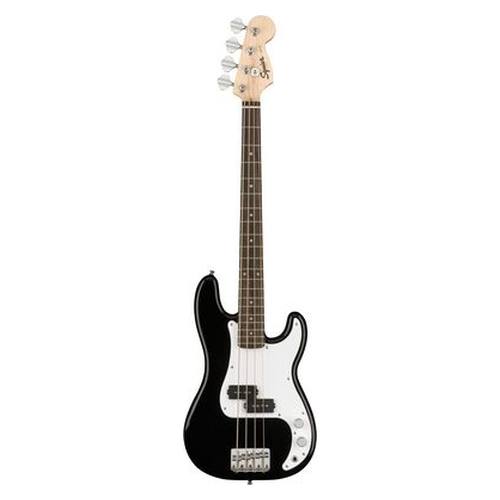
The Mini is a Precision Bass built around a 28.6 inch (726 mm) short-scale neck, about 5.4 inches shorter than the 34 inch neck on the other three basses here. Every fret is closer together and the whole instrument is smaller, so it suits children, adults with small hands and anyone who finds a full-size bass tiring to hold.
Fender describes the body as thin and lightweight. It is poplar with a gloss finish, with a maple C-shape neck, a laurel fingerboard (9.5 inch radius, 20 narrow tall frets) and a 1.5 inch nut, the same as the Sonic. There is one split single-coil Precision Bass pickup with volume and tone, a four-saddle vintage-style bridge and sealed die-cast tuners. Fender specifies lighter .040 to .095 strings.
Key Specs
- Poplar body, gloss polyurethane finish
- Bolt-on maple neck, satin finish, C shape
- Indian laurel fingerboard, 9.5 inch radius, 20 narrow tall frets
- 28.6 inch (726 mm) short scale, 1.5 inch (38.1 mm) synthetic bone nut
- One split single-coil Precision Bass pickup (passive)
- Volume and tone
- Four-saddle vintage-style bridge, sealed die-cast tuners, .040 to .095 strings
Why it made the list
It is the lowest-priced bass here, and it solves a problem the other three do not: physical size. A bass that is too long and heavy is a quiet reason people stop practicing, and at $209.99 the Mini removes that barrier for the smallest players.
It is not only a kid's bass. Plenty of adults choose short scale for comfort, and the Mini plays the same notes in the same positions as a full-size bass, so what you learn carries over when you want a longer neck.
Deep Dive: Who It's Really For
The ideal buyer: A child or teenager starting out, an adult with small hands, or anyone who wants a smaller instrument for practicing at home. It is also a good second bass for travel.
What short scale changes: At the same tuning, a shorter string runs at lower tension, which feels looser under the fingers than on a 34 inch bass. Some players like that and some find it slack, especially on the low strings. The notes and fret positions are the same as on a full-size bass.
What to budget alongside it: Fender lists a gig bag as a recommended accessory, and it is not included. Short-scale strings and a bass-rated amp or interface are the other extras.
▶ Featured Review

Video Reviews & Tutorials
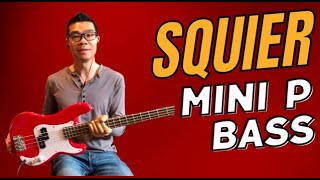
Squier Mini P precision Bass - Demonstration of sounds and comparison with a full size P Bass
Comparison
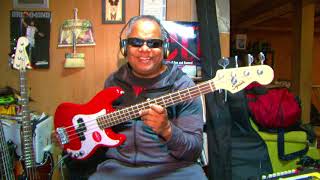
Bass in Your Face! # 96 Squier Mini Precision Bass #squierbass
Full Review
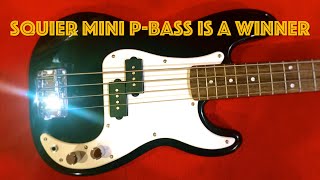
STOCK Squier Mini Precision Bass Wins! This is a Mini Monster.
Full Review
Pros
28.6 inch short scale is the easiest to reach and to hold Lowest price on the list Same P Bass pickup design as the Sonic Lighter strings (.040 to .095) are gentler on young fingersCons
Lower string tension feels looser than a standard 34 inch bass One pickup and a passive circuit, like the Sonic Short-scale string sets are a smaller selection than standard ones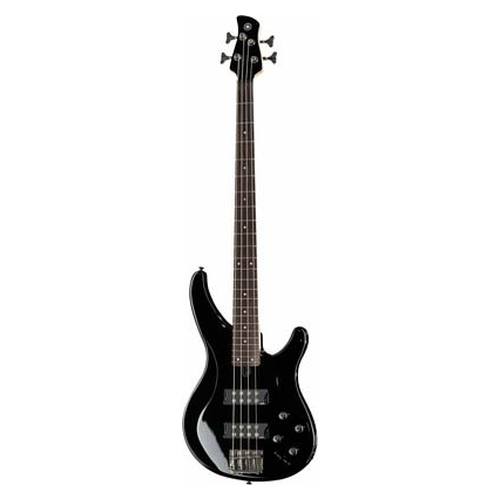
TRBX304
Best Step-Up
Yamaha TRBX304
Price history
We have been recording this product's price at its dealers since July. Player members see the 90-day trend, what it has been at its highest and lowest, and whether today is actually a good day to buy it.
The TRBX304 costs $180 to $240 more than the others, and the extra money buys a more complete instrument. Yamaha builds it with a solid mahogany body and a five-piece maple and mahogany bolt-on neck, and it carries two Yamaha-designed M3 ceramic humbuckers with active electronics: master volume, a pickup balancer, a two-band bass and treble EQ, and a five-position Performance EQ switch.
That switch is the feature to know about. It selects one of five EQ curves that Yamaha designed for common playing situations, so you can move from a rounder, finger-style tone to a scooped sound for slap without touching the EQ knobs. The neck has 24 medium frets on a rosewood fingerboard with a 10 inch radius and a 38 mm nut, and the factory strings are D'Addario EXL170 (.045 to .100).
Key Specs
- Solid mahogany body, gloss polyurethane finish
- Bolt-on 5-piece maple and mahogany neck, satin finish
- Rosewood fingerboard, 10 inch (250 mm) radius, 24 medium frets
- 34 inch (863.6 mm) scale, 38 mm nut, 19.5 mm thick at the 1st fret
- Two YGD-designed M3 ceramic humbuckers
- Active circuit: volume, pickup balancer, 2-band EQ, 5-position Performance EQ switch
- Die-cast bridge, covered die-cast tuners, D'Addario EXL170 strings
Why it made the list
It is the bass on this list that you are least likely to replace. A mahogany body, 24 frets, humbuckers and a full active EQ are features that usually cost more, and they let one instrument handle clean fingerstyle, hard pick playing and slap without a pedal.
At $449.99 it is roughly $180 to $240 more than the other three, so it is a decision, not an impulse buy. If you already know bass is going to stay in your life, it saves the cost of buying twice.
Deep Dive: Who It's Really For
The ideal buyer: An adult or older teenager who is committed, or a player stepping up from a starter bass who wants a lot of tonal range from a single instrument. It works for rock, pop, funk and metal.
What you give up: Both pickups are humbuckers, so you will not get the single-coil P Bass sound of the Squiers or the J-style bridge growl of the Ibanez. Some players find the sound clean and modern compared with a vintage-style P Bass, and the active circuit needs a battery.
Price check: We read $449.99 on Yamaha's own store and at zZounds and Chuck Levin's on the day we checked. Dealers run sales from time to time, so compare before you buy.
▶ Featured Review

Video Reviews & Tutorials
Product Spotlight - Yamaha TRBX304 4 String Electric Bass Guitar
First Look
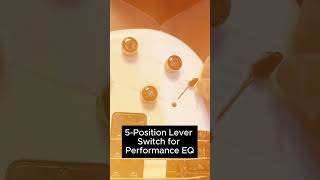
Yamaha TRBX304 Electric 4-String Bass Guitar Review 🎸🔥#yamahabass #bassguitar
Full Review
My Yamaha TRBX304 bass(boring demo).
Sound Demo
Pros
Solid mahogany body, 24 frets and two humbuckers in a beginner-priced range Five-position Performance EQ switch gives instant usable tones Slim neck: 19.5 mm thick at the first fret Strong enough to stay your main bass for yearsCons
$180 to $240 more than the other three Both pickups are humbuckers, so there is no classic P Bass tone The active circuit needs a battery